> ## Documentation Index
> Fetch the complete documentation index at: https://docs.asapp.com/llms.txt
> Use this file to discover all available pages before exploring further.
# Structured Data
> Extract entities and targeted data from your conversations
Structured Data is information extracted from customer-agent utterances and recorded in a standardized format. It extracts specific, customizable data points from conversations and usually takes two forms:
* **Question-based fields**: Capture whether something happened in the conversation.
* **Entity fields**: Capture specific values mentioned in the conversation.
Both come with industry-specific templates that can be customized to fit your unique use cases.
Structured Data's flexible nature enables it to solve numerous challenges, including:
* Automating data collection for analytics and reporting
* Facilitating compliance monitoring and quality assurance
* Populating CRMs and other business tools efficiently
* Supporting data-driven decision-making and process improvement
To design fields, add them in AI Console, and access the extracted data, see [Creating and Retrieving Structured Data](/ai-productivity/ai-summary/structured-data/creating-and-retrieving).
## Structured data forms
These capture whether something happened in the conversation.
**Examples**
* Was the issue resolved?
* Did the customer ask for a supervisor?
* Did the agent offer a refund?
These are typically answered with:
* **Yes**
* **No**
* **Not Found** — when the particular information is not available in the transcript
**Edge cases**
* **Empty transcripts** — when the transcript is void of customer-agent utterances
* **Unresponsive customer** — when any customer responses are missing from the transcript
These capture specific values mentioned in the conversation.
**Examples**
* Order number
* Product name
* Refund amount
* Date of transaction
* Competitor name
These are typically answered with:
* **Text**
* **Date**
* **Amount**
* **ID/String**
## How it works
Here's an example conversation to demonstrate how Structured Data works:
> **Agent**: Hello, thank you for contacting XYZ Insurance. How can I assist you today?\
> **Customer**: Hi, I want to check the status of my payout for my claim.\
> **Agent**: Sure, can you please provide me with the claim number?\
> **Customer**: It's H123456789.\
> **Agent**: Thank you. Could you also provide the last 4 digits of your account number?\
> **Customer**: 6789\
> **Agent**: Let me check the details for you. One moment, please.\
> **Agent**: I see that your claim was approved on June 10, 2024, for \$5000. The payout has been processed.\
> **Customer**: Great! When will I receive the money?\
> **Agent**: The payout will be credited to your account within 3-5 business days.\
> **Customer**: Perfect, thank you so much for your help.\
> **Agent**: You’re welcome! Is there anything else I can assist you with?\
> **Customer**: No, that's all. Have a nice day.\
> **Agent**: You too. Goodbye!
AI Summary analyzes this conversation and extracts structured data in two ways:
Entity Extraction automatically identifies and extracts specific information from conversations. Extracted entities can include claim numbers, account details, dates, monetary amounts, and more.
For the example conversation above, the extracted entities would look like this:
```javascript theme={null}
[
{
"name": "Claim Number",
"value": "H123456789"
},
{
"name": "Account Number Last 4",
"value": "5678"
},
{
"name": "Approval Date",
"value": "2024-06-10"
},
{
"name": "Payout Amount",
"value": 5000
}
]
```
Targeted Structured Data (Questions) provides answers to predefined queries based on conversation content. You can customize these questions to address specific aspects of customer interactions, compliance requirements, or other relevant factors.
For the example conversation above, predefined questions and their answers would look like this:
```javascript theme={null}
[
{
"name": "Customer Satisfied",
"answer": "Yes"
},
{
"Name": "Payout Information Provided",
"answer": "Yes"
},
{
"name": "Verification Completed",
"answer": "Yes"
}
]
```
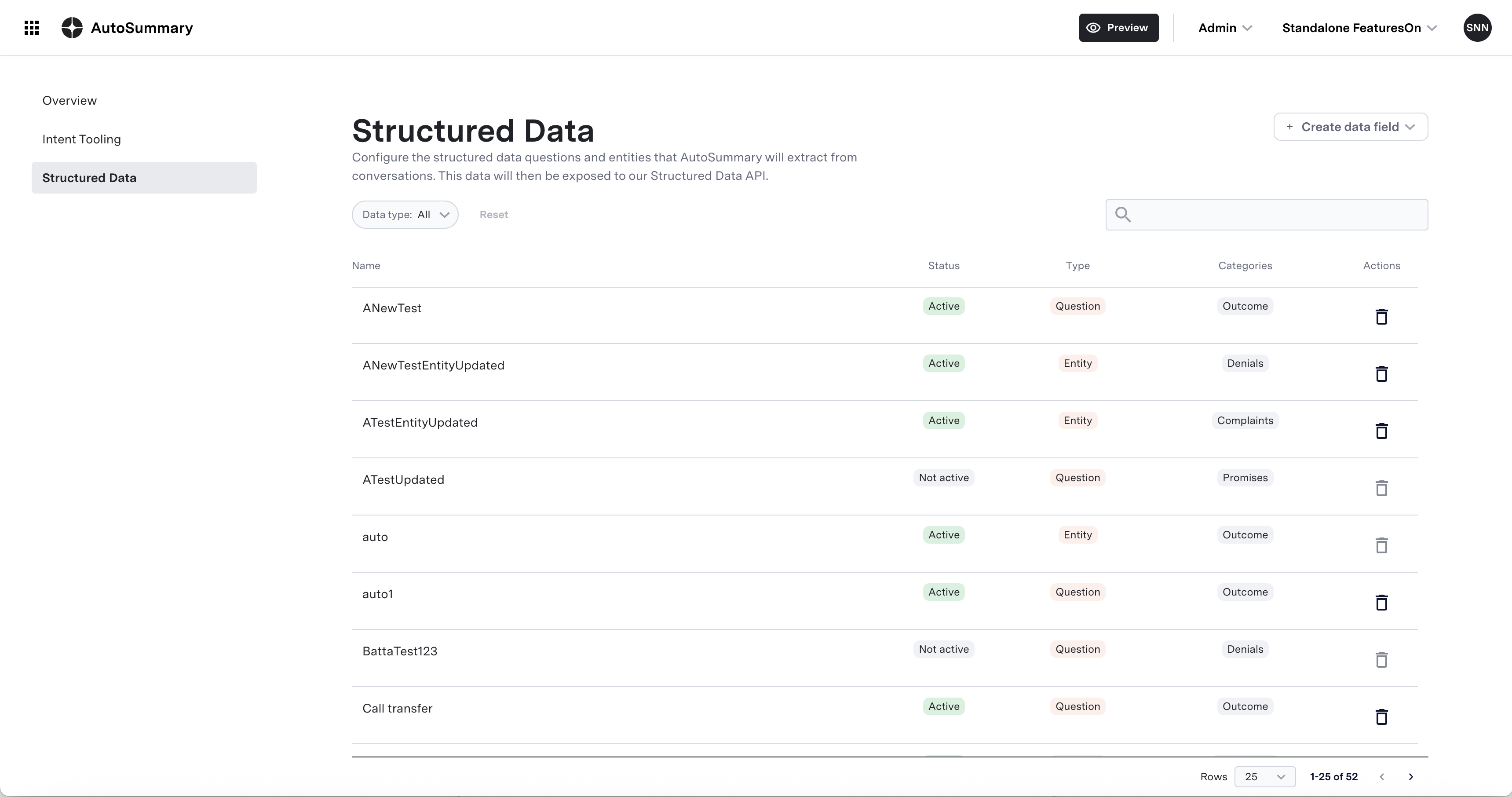
## Structured Data dashboard
Use the Structured Data dashboard to configure which entities or questions you want to extract. Once configured, ASAPP will return the extracted structured data.
The Structured Data dashboard enables you to:
* **Add new entities**: Define fields to extract from conversations, such as order numbers, dates, amounts, or other relevant data points.
* **Add new questions**: Create targeted questions to answer based on conversation content. Tailor these questions to your specific use cases, including compliance checks, behavioral insights, or downstream workflows.
* **Modify or delete existing entities and questions**: Rename, change types, or update parameters for existing entities or questions to better suit your requirements. Remove any entities or questions that are no longer needed.
* **Control visibility and lifecycle**: Enable or disable fields based on team, workflow, or environment.
* **Preview changes**: Preview and validate extraction behavior before publishing.
 ## Common types of structured data
A strong Structured Data design usually includes a mix of the following:
Questions answered with Yes/No.
**Examples**
* Did the customer mention a competitor?
* Did the agent offer a promotion?
* Did the customer request escalation?
Fields that capture a specific value.
**Examples**
* Competitor name
* Transaction date
* Refund amount
* Plan of interest
* Product model
Most Structured Data questions are answered with Yes or No. However, there are rare cases where **Not Found** may be applicable.
Not Found is present only when:
* the question genuinely does not apply
* the conversation does not contain enough evidence
* the interaction ends abruptly before the answer can be determined
| Question | Answer type |
| ------------------------------------------------------------------------------------------------ | ----------------------- |
| Was the customer satisfied with the information provided and the actions taken by the agent? | Not Found in edge cases |
| Did the customer demonstrate genuine, non-sarcastic appreciation at the end of the conversation? | Not Found in edge cases |
Currently, Structured Data does not support **"Conditional Flows"** or **"if then"** cases, as that feature is not available. If a workflow requires dependencies between fields, we recommend modeling those fields as separate, independently defined attributes.
## Recommended categories
* **Intent identification**: Assess the customer's purpose for contacting support.
* **Resolution tracking**: Determine if the interaction led to a resolution.
* **Customer sentiment & emotional tone**: Capture the customer's emotional tone.
* **Agent behavior & performance**: Evaluate the agent's handling of the situation.
* **Process and policy communication**: Evaluate clear communication of key policies or steps.
* **Channel & communication flow**: Assess how the conversation was conducted.
* **Verification & authentication**: Assess standard customer verification procedures.
## General structured data questions
The following questions are broad, domain-agnostic, and can be applied across many industries.
| Question | Answer type |
| -------------------------------------------------------------------------------------------------------------------- | ------------------ |
| Did the customer mention the names of any competitors? | Yes/ No/ Not Found |
| Was the issue the customer contacted about resolved? | Yes/ No/ Not Found |
| Was the customer satisfied with the answer provided by the agent? | Yes/ No/ Not Found |
| Did the customer raise a complaint about staff or service during the conversation? | Yes/ No/ Not Found |
| Did the customer ask to escalate or speak to a supervisor or manager? | Yes/ No/ Not Found |
| Did the customer display frustration or anger during the conversation? | Yes/ No/ Not Found |
| Did the agent schedule a follow-up or callback for the issue? | Yes/ No/ Not Found |
| Did the customer mention contacting support again about an issue they believed should have been resolved previously? | Yes/No/ Not Found |
| Did the customer mention an issue with the website? | Yes/No/ Not Found |
These questions are useful because they focus on observable behaviors and outcomes that are relevant across industries.
## Industry-specific question examples
In addition to general questions, many organizations need Structured Data tailored to their industry. These examples can be adapted to match your products, policies, and customer journey.
| Question | Answer type |
| -------------------------------------------------------------------- | ------------------ |
| Did the customer mention that another airline’s services are better? | Yes/ No/ Not Found |
| Did the customer report an issue with airplane cleanliness? | Yes/ No/ Not Found |
| Did the agent offer a travel credit card? | Yes/ No/ Not Found |
| Did the customer express interest in upgrading their seat or cabin? | Yes/ No/ Not Found |
| Question | Answer type |
| ------------------------------------------------------------------------------- | ------------------ |
| Did the customer indicate they were having trouble understanding their bill? | Yes/ No/ Not Found |
| Did the customer threaten to move to a lower-tier plan or cancel their service? | Yes/ No/ Not Found |
| Did the agent provide details about 5G home internet service? | Yes/ No/ Not Found |
| Did the customer show interest in upgrading their plan or internet speed? | Yes/ No/ Not Found |
| Question | Answer type |
| -------------------------------------------------------------------------------------------- | ------------------ |
| Did the customer apply for a credit card? | Yes/ No/ Not Found |
| Did the customer dispute the usage of their credit card for a specific transaction? | Yes/ No/ Not Found |
| Did the customer want to make, or did they make, a payment to their credit card account? | Yes/ No/ Not Found |
| Did the customer report an error with an electronic transfer? | Yes/ No/ Not Found |
| Did the customer express interest in setting up recurring payments to pay service providers? | Yes/ No/ Not Found |
| Did the customer express interest in learning about or opening a new credit account? | Yes/ No/ Not Found |
| Did the customer mention difficulty adding another user to their account? | Yes/ No/ Not Found |
| Question | Answer type |
| ------------------------------------------------------------------------------------------------------- | ------------------ |
| Did the customer mention they might cancel their order or reduce the size of their order? | Yes/ No/ Not Found |
| Did the customer express interest in additional products beyond their existing purchase? | Yes/ No/ Not Found |
| Did the agent ask whether the customer was interested in learning more about store membership benefits? | Yes/ No/ Not Found |
| Question | Answer type |
| ------------------------------------------------------------------------------------- | ------------------ |
| Did the agent refuse a request for a reduction in insurance cost? | Yes/ No/ Not Found |
| Did the customer show interest in increasing current coverage or adding new coverage? | Yes/ No/ Not Found |
| Did the customer disagree with the settlement amount or payout? | Yes/ No/ Not Found |
| Question | Answer type |
| ---------------------------------------------------------------------------------------------------------------------------------------- | ------------------ |
| Did the agent deny a request to cancel a trade? | Yes/ No/ Not Found |
| Did the customer say they had difficulty making a trade? | Yes/ No/ Not Found |
| Did the agent ask whether the customer was interested in receiving more information about personal advising or speaking with an advisor? | Yes/ No/ Not Found |
| Question | Answer type |
| --------------------------------------------------------------------------------- | ------------------ |
| Did the agent extend an offer for a promotional deal, discount, or special offer? | Yes/ No/ Not Found |
| Did the agent offer credit or a refund to the customer? | Yes/ No/ Not Found |
| Did the agent deny a requested credit or refund? | Yes/ No/ Not Found |
## Capturing entities
Entities are specific pieces of information mentioned in a conversation that should be captured as values rather than Yes/No answers. They help add detail and context to your analysis.
Common entity types include:
* Customer name
* Organization names
* Competitor names
* Product names
* Services
* Order numbers
* Dates
* Charges or refund amounts
* Plan names
* Cancellation reasons
### Example entity fields
| Domain | Field | Answer type | Example |
| ------------------ | ----------------------------------------------------------------- | ------------------- | ------------------------------------- |
| All | Names of competitors mentioned by the customer | Text | Norton, AT\&T, Puma |
| All | Dollar amount refunded/charged/credited | Amount | \$100 |
| All | Date of when the transaction occurred | Date | 05/23/2021 or May 23, 2021 |
| E-Commerce | Order number shared by the customer | Alphanumeric string | A0957281BN |
| E-Commerce | Product name mentioned by the customer | Text | Sony W1000XM5 |
| Telco | Name of the promotion/discount offered by the agent | Text | One year free service |
| Telco | Plan of interest mentioned by the customer | Text | Unlimited Plus |
| Telco | Plan or service that the customer wants to cancel | Text | Internet, Mobile Line |
| Telco | The customer’s cancellation reason of the plan/service | Text | Switched to another carrier |
| Telco | Desired model or service for upgrade | Text | Samsung Galaxy S24 |
| E-Commerce / Telco | The type of bill that the customer mentions / is contacting about | Text | Monthly Bill, Past Due, Recurring Fee |
## Next steps
Learn how to create structured data questions and entities and retrieve the extracted data
Learn how to use Segments to control which SD questions are extracted for different types of conversations
## Common types of structured data
A strong Structured Data design usually includes a mix of the following:
Questions answered with Yes/No.
**Examples**
* Did the customer mention a competitor?
* Did the agent offer a promotion?
* Did the customer request escalation?
Fields that capture a specific value.
**Examples**
* Competitor name
* Transaction date
* Refund amount
* Plan of interest
* Product model
Most Structured Data questions are answered with Yes or No. However, there are rare cases where **Not Found** may be applicable.
Not Found is present only when:
* the question genuinely does not apply
* the conversation does not contain enough evidence
* the interaction ends abruptly before the answer can be determined
| Question | Answer type |
| ------------------------------------------------------------------------------------------------ | ----------------------- |
| Was the customer satisfied with the information provided and the actions taken by the agent? | Not Found in edge cases |
| Did the customer demonstrate genuine, non-sarcastic appreciation at the end of the conversation? | Not Found in edge cases |
Currently, Structured Data does not support **"Conditional Flows"** or **"if then"** cases, as that feature is not available. If a workflow requires dependencies between fields, we recommend modeling those fields as separate, independently defined attributes.
## Recommended categories
* **Intent identification**: Assess the customer's purpose for contacting support.
* **Resolution tracking**: Determine if the interaction led to a resolution.
* **Customer sentiment & emotional tone**: Capture the customer's emotional tone.
* **Agent behavior & performance**: Evaluate the agent's handling of the situation.
* **Process and policy communication**: Evaluate clear communication of key policies or steps.
* **Channel & communication flow**: Assess how the conversation was conducted.
* **Verification & authentication**: Assess standard customer verification procedures.
## General structured data questions
The following questions are broad, domain-agnostic, and can be applied across many industries.
| Question | Answer type |
| -------------------------------------------------------------------------------------------------------------------- | ------------------ |
| Did the customer mention the names of any competitors? | Yes/ No/ Not Found |
| Was the issue the customer contacted about resolved? | Yes/ No/ Not Found |
| Was the customer satisfied with the answer provided by the agent? | Yes/ No/ Not Found |
| Did the customer raise a complaint about staff or service during the conversation? | Yes/ No/ Not Found |
| Did the customer ask to escalate or speak to a supervisor or manager? | Yes/ No/ Not Found |
| Did the customer display frustration or anger during the conversation? | Yes/ No/ Not Found |
| Did the agent schedule a follow-up or callback for the issue? | Yes/ No/ Not Found |
| Did the customer mention contacting support again about an issue they believed should have been resolved previously? | Yes/No/ Not Found |
| Did the customer mention an issue with the website? | Yes/No/ Not Found |
These questions are useful because they focus on observable behaviors and outcomes that are relevant across industries.
## Industry-specific question examples
In addition to general questions, many organizations need Structured Data tailored to their industry. These examples can be adapted to match your products, policies, and customer journey.
| Question | Answer type |
| -------------------------------------------------------------------- | ------------------ |
| Did the customer mention that another airline’s services are better? | Yes/ No/ Not Found |
| Did the customer report an issue with airplane cleanliness? | Yes/ No/ Not Found |
| Did the agent offer a travel credit card? | Yes/ No/ Not Found |
| Did the customer express interest in upgrading their seat or cabin? | Yes/ No/ Not Found |
| Question | Answer type |
| ------------------------------------------------------------------------------- | ------------------ |
| Did the customer indicate they were having trouble understanding their bill? | Yes/ No/ Not Found |
| Did the customer threaten to move to a lower-tier plan or cancel their service? | Yes/ No/ Not Found |
| Did the agent provide details about 5G home internet service? | Yes/ No/ Not Found |
| Did the customer show interest in upgrading their plan or internet speed? | Yes/ No/ Not Found |
| Question | Answer type |
| -------------------------------------------------------------------------------------------- | ------------------ |
| Did the customer apply for a credit card? | Yes/ No/ Not Found |
| Did the customer dispute the usage of their credit card for a specific transaction? | Yes/ No/ Not Found |
| Did the customer want to make, or did they make, a payment to their credit card account? | Yes/ No/ Not Found |
| Did the customer report an error with an electronic transfer? | Yes/ No/ Not Found |
| Did the customer express interest in setting up recurring payments to pay service providers? | Yes/ No/ Not Found |
| Did the customer express interest in learning about or opening a new credit account? | Yes/ No/ Not Found |
| Did the customer mention difficulty adding another user to their account? | Yes/ No/ Not Found |
| Question | Answer type |
| ------------------------------------------------------------------------------------------------------- | ------------------ |
| Did the customer mention they might cancel their order or reduce the size of their order? | Yes/ No/ Not Found |
| Did the customer express interest in additional products beyond their existing purchase? | Yes/ No/ Not Found |
| Did the agent ask whether the customer was interested in learning more about store membership benefits? | Yes/ No/ Not Found |
| Question | Answer type |
| ------------------------------------------------------------------------------------- | ------------------ |
| Did the agent refuse a request for a reduction in insurance cost? | Yes/ No/ Not Found |
| Did the customer show interest in increasing current coverage or adding new coverage? | Yes/ No/ Not Found |
| Did the customer disagree with the settlement amount or payout? | Yes/ No/ Not Found |
| Question | Answer type |
| ---------------------------------------------------------------------------------------------------------------------------------------- | ------------------ |
| Did the agent deny a request to cancel a trade? | Yes/ No/ Not Found |
| Did the customer say they had difficulty making a trade? | Yes/ No/ Not Found |
| Did the agent ask whether the customer was interested in receiving more information about personal advising or speaking with an advisor? | Yes/ No/ Not Found |
| Question | Answer type |
| --------------------------------------------------------------------------------- | ------------------ |
| Did the agent extend an offer for a promotional deal, discount, or special offer? | Yes/ No/ Not Found |
| Did the agent offer credit or a refund to the customer? | Yes/ No/ Not Found |
| Did the agent deny a requested credit or refund? | Yes/ No/ Not Found |
## Capturing entities
Entities are specific pieces of information mentioned in a conversation that should be captured as values rather than Yes/No answers. They help add detail and context to your analysis.
Common entity types include:
* Customer name
* Organization names
* Competitor names
* Product names
* Services
* Order numbers
* Dates
* Charges or refund amounts
* Plan names
* Cancellation reasons
### Example entity fields
| Domain | Field | Answer type | Example |
| ------------------ | ----------------------------------------------------------------- | ------------------- | ------------------------------------- |
| All | Names of competitors mentioned by the customer | Text | Norton, AT\&T, Puma |
| All | Dollar amount refunded/charged/credited | Amount | \$100 |
| All | Date of when the transaction occurred | Date | 05/23/2021 or May 23, 2021 |
| E-Commerce | Order number shared by the customer | Alphanumeric string | A0957281BN |
| E-Commerce | Product name mentioned by the customer | Text | Sony W1000XM5 |
| Telco | Name of the promotion/discount offered by the agent | Text | One year free service |
| Telco | Plan of interest mentioned by the customer | Text | Unlimited Plus |
| Telco | Plan or service that the customer wants to cancel | Text | Internet, Mobile Line |
| Telco | The customer’s cancellation reason of the plan/service | Text | Switched to another carrier |
| Telco | Desired model or service for upgrade | Text | Samsung Galaxy S24 |
| E-Commerce / Telco | The type of bill that the customer mentions / is contacting about | Text | Monthly Bill, Past Due, Recurring Fee |
## Next steps
Learn how to create structured data questions and entities and retrieve the extracted data
Learn how to use Segments to control which SD questions are extracted for different types of conversations